Quick Facts
Product information at a glance.
CodeT-13
CategoryECDown Bio Liquid Fertilizer for Salinity and Root-Zone Management
PositioningSoil EC management and root-zone recovery nutrition
DocumentsTDS / COA / MSDS request gate
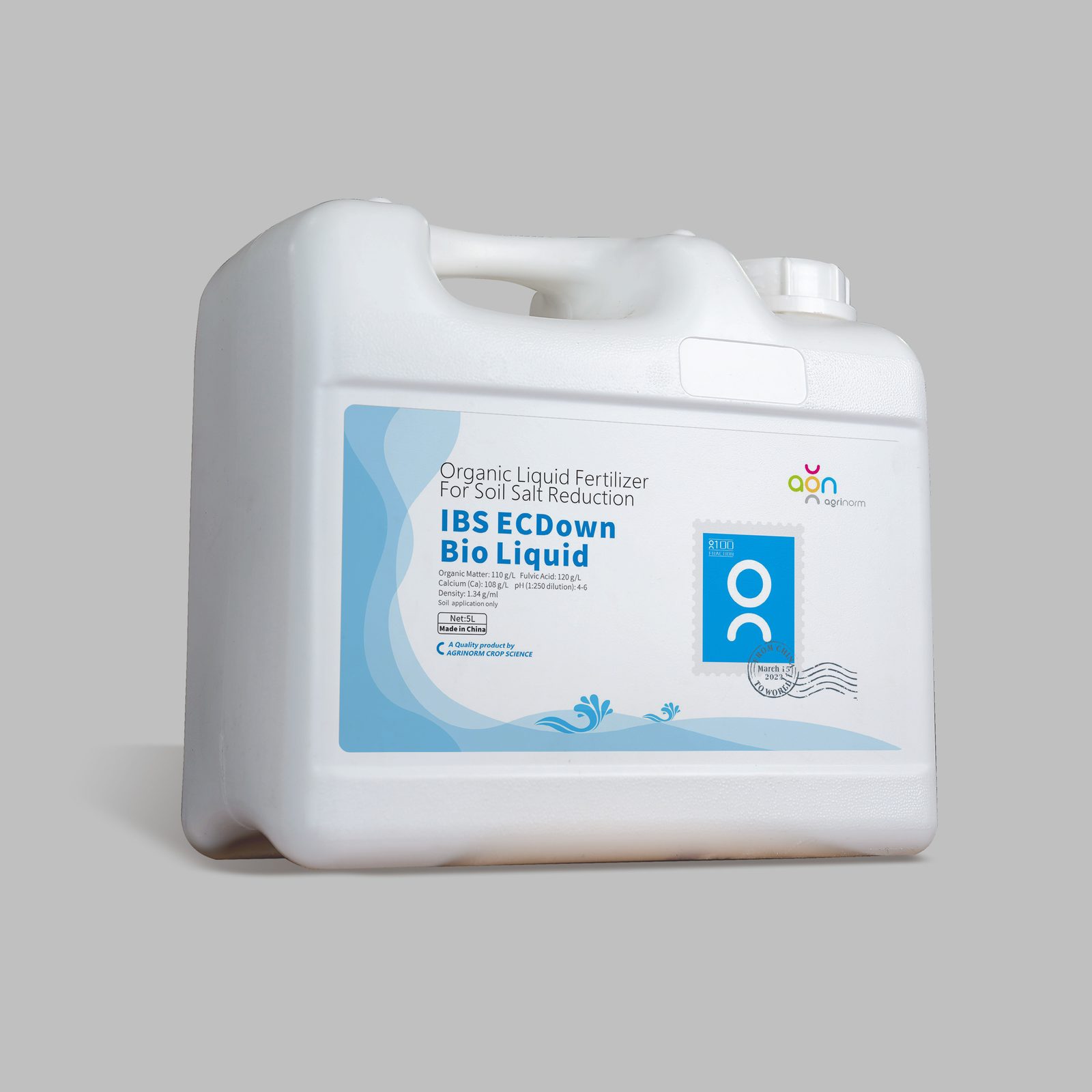
Soil-application ECDown bio liquid fertilizer for salinity management, calcium nutrition and root-zone recovery programs.
IBS ECDown Bio Liquid is positioned for distributors who need a soil-application product for high EC, saline irrigation, weak emergence, poor seedling establishment and root-zone stress programs.
IBS ECDown Bio Liquid is aligned with the domestic product EC DOWN Pro and supported by TDS data. It is positioned as an organic liquid fertilizer for soil salt reduction, combining organic matter, fulvic acid and calcium nutrition for root-zone programs under compliant fertilizer wording.
| Product category | ECDown Bio Liquid Fertilizer for Salinity and Root-Zone Management |
|---|---|
| Portfolio stage | Functional Biostimulants / Functional Biostimulants |
| Domestic source product | EC DOWN Pro |
| TDS source | T-13, revision 1.0, date 2026-06-10 |
| Product type | organic liquid fertilizer for soil salt reduction |
| Organic matter | 110 g/L |
| Fulvic acid | 120 g/L |
| Calcium (Ca) | 108 g/L |
| pH (1:250 dilution) | 4-6 |
| Density | 1.34 g/mL |
| Appearance | liquid |
| Recommended use | soil application only |
| Application | Soil application only. Apply through irrigation, drip system or soil drench according to crop stage, TDS and local label. Do not position as a foliar product. Perform a jar test before tank mixing and avoid direct mixing with strong acids, strong alkalis or highly oxidizing materials unless compatibility is confirmed. |
Soil application only. Apply through irrigation, drip system or soil drench according to crop stage, TDS and local label. Do not position as a foliar product. Perform a jar test before tank mixing and avoid direct mixing with strong acids, strong alkalis or highly oxidizing materials unless compatibility is confirmed.
Perform a jar test before tank mixing. Final compatibility, rate and timing should follow the TDS, destination-market label and agronomist guidance.
Position this product as a fertilizer or crop nutrition input. Avoid disease-control or pesticide-style claims unless supported by local registration.